Los Nidos de David
Basic nest box for tits
Basic nest box for tits
Couldn't load pickup availability
This basic nest box for tits is designed to encourage nesting of insectivorous birds such as great tits and blue tits, helping with biological pest control and increasing biodiversity.
Why install a nest box for tits?
Birds from the tit family, such as great tits and blue tits, use natural cavities for breeding, but these are increasingly scarce due to intensive pruning, the removal of old trees, and urbanization.
Installing a nest box for tits helps to compensate for this lack of natural shelters, facilitating the reproduction of these insectivorous birds and promoting their stable presence in gardens, orchards, and agricultural farms. Furthermore, it is a simple and direct way to contribute to the conservation of local biodiversity.
Benefits for biological pest control
Tits are excellent allies in biological pest control, as during the breeding season they feed mainly on insects such as caterpillars, aphids, larvae, and other invertebrates that can damage crops, fruit trees, and ornamental plants.
A single pair can consume thousands of insects throughout the breeding season, naturally reducing the need for chemical products. For this reason, the installation of nest boxes is an increasingly used practice in organic farming, family orchards, and sustainable land management projects.
Designed to be occupied (not decorative)
This nest box is manufactured following real nesting criteria:
- Natural wood from sustainable forests
- Appropriate dimensions for chick development
- Entrance hole adapted for specific species
- Design intended to offer security
The goal is not for it to be pretty, but for it to work.
Entrance hole diameter and target species
The diameter of the entrance hole is a key element in a nest box for tits, as it determines which species can use it and helps prevent larger birds from entering.
This nest box includes several entrance hole diameter options adapted to different tit species, with an appropriate size to ensure their access and safety during nesting. A correct diameter favors the use of the box by these species and reduces the risk of competition or disturbance from other birds.
For example, a 26 mm hole is ideal for the blue tit and coal tit, while a 28 mm hole is suitable for the crested tit. A diameter of 32 mm is appropriate for the great tit and tree sparrow, and 35 mm for the house sparrow.
Assembled nest box or assembly kit for environmental education
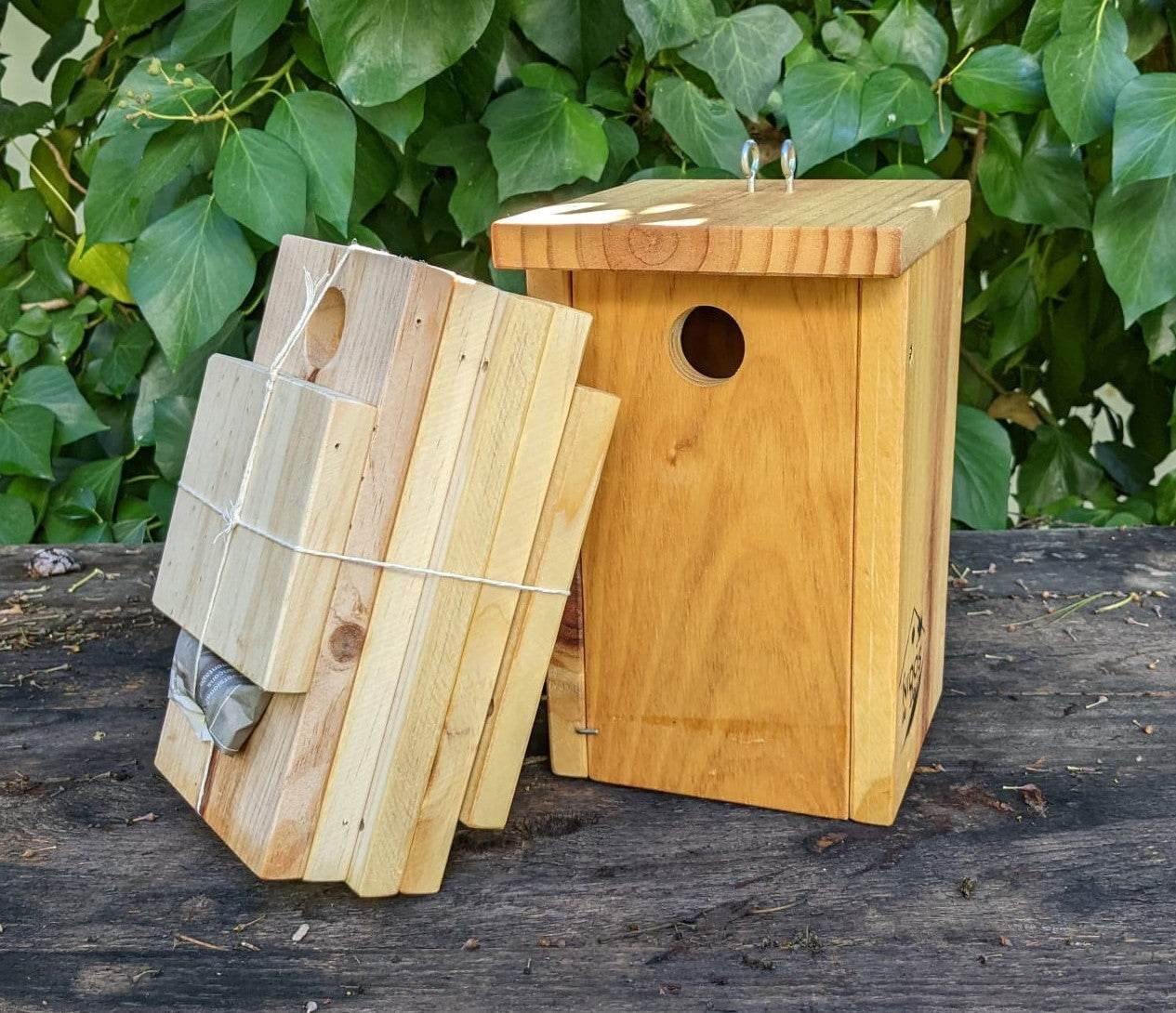
This nest box for tits is available both assembled, ready to install, and as an assembly kit, designed for environmental education activities, school workshops, and participatory projects.
The assembly kit allows children and adults to better understand the importance of insectivorous birds and their role in biological pest control, fostering practical learning and respect for nature. Once assembled, the nest box offers the same features and safety as the assembled version.
How to get real results (key)
This is where there is often the most confusion. Many times a single nest box is installed expecting immediate results, but in nature, it doesn't work that way.
Tits are territorial birds, but they also need a certain availability of shelters in an area to settle. Furthermore, not all boxes are occupied in the first year.
Therefore, when working with this type of solution in organic farming or farm management, it is common to install several boxes, not just one.
This allows:
- Increasing the likelihood of occupation from the first year
- Encouraging more than one pair to settle
- Creating a cumulative effect on pest control
- Better adapting to the birds' preferences (location, orientation, environment)
In other words: it's not about "trying with one", but about creating real conditions for it to work.
Recommendation based on space
Depending on the size of the area:
- 1 nest box → suitable for starting or very small spaces
- 3 nest boxes → ideal for gardens and orchards, significantly increases the probability of occupation
- 5 or more nest boxes → recommended for larger farms or land, where a real impact on biodiversity and pest control is sought
This is how work is done when a real result is sought, not just a one-time installation.
To get the most out of this nest box and ensure proper maintenance, we recommend consulting our blog guides on nest box maintenance and how to place a nest box, where you will find practical tips for cleaning, placement, and care over time.
Characteristics
Characteristics
- Made with pine wood from sustainably managed forests with FSC or PEFC certification.
- We use 18mm thick wooden boards, which gives it great strength and durability.
- The pieces are joined together using lag screws instead of nails, achieving greater strength and durability.
- Exterior varnished with a coat of raw linseed oil (no drying agents).
- It has a front opening for easy access inspection and cleaning of the box.
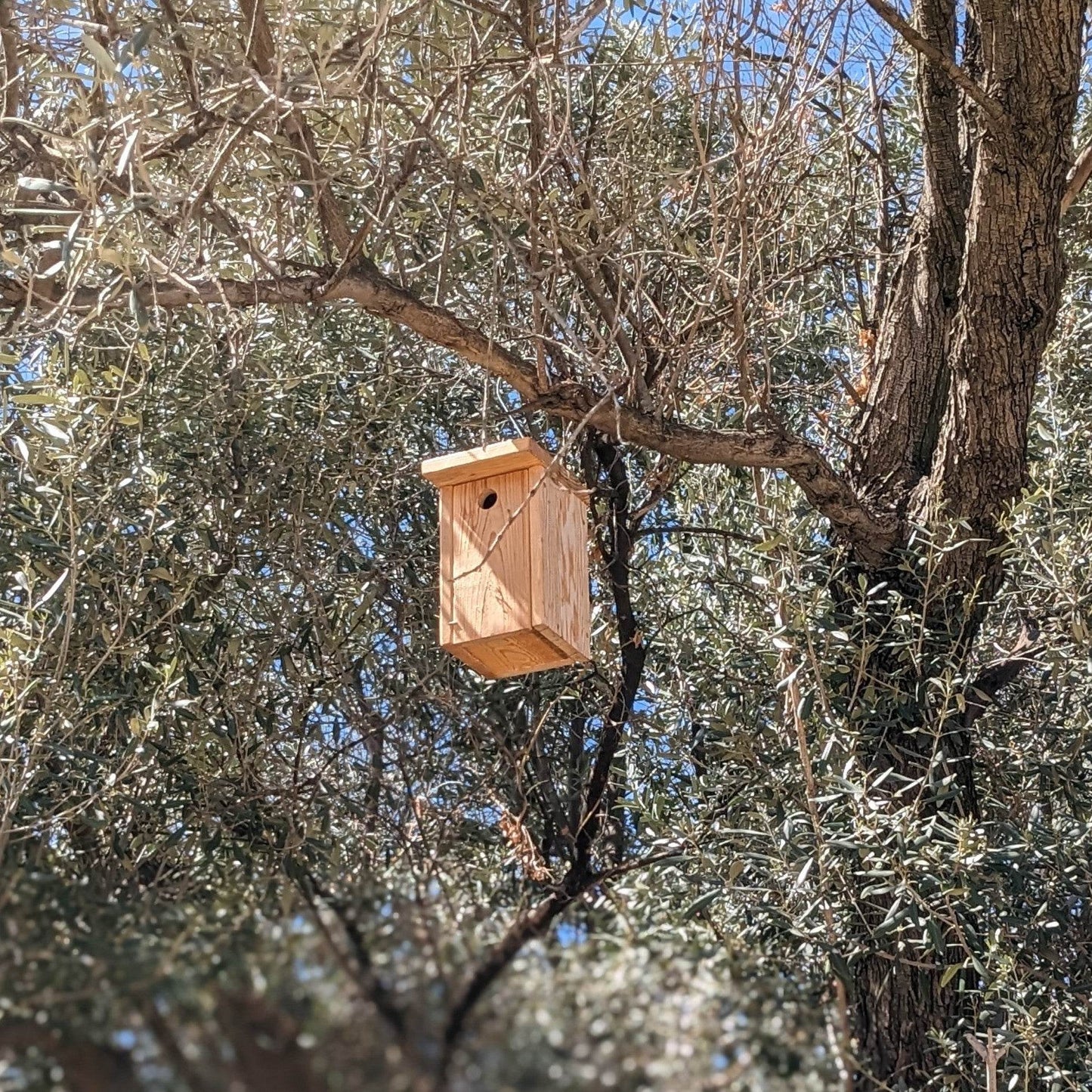
- The box has two holes in the ceiling to accommodate two eyebolts (also included) for easy hanging. A hook is included for hanging it on a tree.
- At the base it has a small drainage hole to prevent water accumulation in case of rain.
Technical sheet
Technical sheet
- Width: 15.5 cm
- Height: 25 cm
- Depth: 17 cm
- Weight: 1.5 Kg
Target species
Target species
- 26 mm inlet: common blue tit (Cyanistes caeruleus), coal tit (Periparus ater)
- 28 mm inlet: crested tit (Lophophanes cristatus)
- 32mm input: Great tit (Parus major), tree sparrow (Passer montanus)
- 35mm input: House Sparrow (Passer domesticus)
Share